Sunday, March 31, 2024

Griffin Home Fandom

family guy house

Horace dies in "Save the Clam", leaving the guys to try to find a way to save the bar from foreclosure. Eventually, Jerome shows up and reveals he bought the Clam with his sports earnings, allowing it to stay open. As seen in "Stewie B. Goode", Brian takes Stewie to the Clam in an effort to persuade him of the dangers of alcohol. Brian is unsuccessful in his attempt, and is so drunk that he is unable to drive, giving an equally intoxicated Stewie his car keys. Stewie crashes Brian's Prius through the wall of the bar, an event shown on the news by Tom Tucker in an attempt to expose Peter.

Brian Griffin's House of Payne

The next day, noticing Lois pulling out of the driveway, Peter throws Stewie behind her rear tire, making it appear that Lois has run him over. Lois suggests they frame someone else, but Peter only professes his love for her, suggesting they take Stewie to the hospital. Payne left Kean College after a few years and worked at Urban Data Systems, a computer forms company founded by his uncle William. He later held jobs as a toll collector and a student busing coordinator for Essex County. In late 2005, he was elected to the Essex County Board of Freeholders (now called county commissioners), and half a year later he was also elected to the Newark city council. Throughout its storied history, Family Guy has navigated myriad challenges, from cancellation to revival, all while retaining its signature brand of humor.

Fox 2021 Schedule: ‘The Masked Singer’ and ‘The Big Leap’ in the Fall, Plus What’s Held for Midseason?

God and Jesus escape by driving away in their Cadillac Escalade, but a blind Peter, without realizing it, rescues Horace from the inferno and becomes a local hero. The Drunken Clam becomes a Karaoke Bar in "Don't Make Me Over", as the gang helps Horace to put the bar back on its feet against the competition from a new shopping mall. Other renovation attempts, including the original theme to the film Coyote Ugly, had previously failed. The Griffin Home on 31 Spooner Street in Quahog, Rhode Island is the home of Griffin Family. For many years, the home appeared on no maps of the street or city, and was briefly the only complete house in the nation of Petoria, where it was also the executive office, as seen in "E. Peterbus Unum".

Stars You Didn’t Know Voiced Animated TV Characters (PHOTOS)

Select regional DVD releases to state on the rear cover "Meet the Griffins and find out what in the name of Quonochontaug, Rhode Island is going on in their heads!", giving "Quonochontaug" as the name for the fictional Quahog. Many of the features of Quahog exist in Quonochontaug, such as a coast. Since its premiere, Family Guy has received generally positive reviews. In 2009, it was nominated for a Primetime Emmy Award for Outstanding Comedy Series, the first time an animated series had been nominated for the award since The Flintstones in 1961. Due to Cleveland's absence from Family Guy, Peter, Quagmire and Joe meet their new black friend, Jerome, in "Jerome Is the New Black". In "Road to the Multiverse",[8] it is revealed that if Frank Sinatra had never been born, The Clam would be long abandoned as of 2009 in the Apocalyptic Universe, as it is seen in shambles.
family guy house

‘Family Guy’ Season Premiere: Brian Dates a Sick Woman…and Becomes a Chick Magnet (VIDEO)

Payne loved basketball, especially the Seton Hall University Pirates, said Sires. He also was committed to issues important to his district, including housing, health care and transportation. Sires said they both worked to secure funding to replace the Portal North Bridge, which carries Amtrak’s Northeast Corridor and NJ Transit commuter trains over the Hackensack River east of Newark. Payne, a Democrat, represented New Jersey’s 10th District since he won a 2012 special election to succeed his late father, who had been New Jersey’s first Black member of Congress.

Best Lines of the Week (October 28-November : ‘I Left a Lame Excuse in the Oven!’

Until last summer, Mr. Azzarello seemed to have lived a relatively quiet life. After high school, where he was a member of a bowling team, he graduated from the University of North Carolina at Chapel Hill in 2009, with degrees in anthropology and public policy. If the governor does not call a special election, Democratic county committee members from the counties in Payne’s district could select someone to replace him on the November ballot. Shortly after his father’s 2012 death, Payne announced his intention to run for his seat. He won a special election to complete the final weeks of his father’s term in the 112th Congress and easily won reelection since.

‘Sons of Anarchy’ Creator & ‘Westworld’ Star Join the Outcry Against Fox News

Set in the fictional city of Quahog, Rhode Island, the show exhibits much of its humor in the form of metafictional cutaway gags that often lampoon American culture. "Brian Griffin's House of Payne" is the 15th episode of the eighth season of the animated comedy series Family Guy. The episode features Brian after he discovers an old script he had written that Stewie found in the basement, and subsequently pitches the show to television executives. The show is quickly and dramatically altered by the executives and James Woods, however, much to Brian's frustration, who nevertheless attempts to adapt to the new format. Meanwhile, Chris and Meg attempt to hide the fact that Stewie is unconscious, after they accidentally bump him down a flight of stairs in the house.

It received mixed reviews from critics for its storyline and many cultural references. According to Nielsen ratings, it was viewed in 7.27 million homes in its original airing. The episode featured guest performances by Jennifer Birmingham, Rob Lotterstein, Danielle Panabaker, Charlie Sheen, Elijah Wood and James Woods, along with several recurring guest voice actors for the series.

Samsung found a new smart home evangelist in 'Family Guy' - Engadget

Samsung found a new smart home evangelist in 'Family Guy'.

Posted: Fri, 31 Aug 2018 07:00:00 GMT [source]

"I kept telling this one person during a recording session that I was happy to sing a line but don’t expect it to sound well. For two hours, they made me sing in agony." As MacFarlane explains, "Sometimes singing is the only way out of a scene." Brian meets and falls in love with Jess, who reveals she has cancer; Brian proposes marriage to her. When Brian falls in love with a tech support worker, he and Stewie travel to India to find her. Quagmire is reunited with a former lover in Korea; Stewie is concerned that he will be a redhead.

In the rest of the video, which is streaming above, the group names their favorite episodes and celebrity cameos. When Alex Bornstein voiced "Woman with Luna Bar for Woman" in the "Island Adventure" episode. Don't look now, but Family Guy is celebrating its 25th anniversary this year.

"Brian Griffin's House of Payne" was released on DVD along with ten other episodes from the season on December 13, 2011. The cast of Family Guy comprises a talented ensemble of voice actors who breathe life into the show’s eclectic array of characters. At the helm is creator Seth MacFarlane, who lends his voice to several key roles, including the bumbling patriarch Peter Griffin, the erudite martini-swilling dog Brian, and the diabolical baby Stewie. Joining MacFarlane are voice actors Alex Borstein, Seth Green, Mila Kunis, and numerous others, each bringing their own unique vocal talents to the table.

While The Simpsons had long been hailed as the reigning champion of animated comedy, Family Guy carved out its own niche with its irreverent take on modern life and pop culture. With its rapid-fire jokes, cutaway gags, and colorful cast of characters, Family Guy captured the attention of audiences worldwide, establishing itself as a formidable force in the realm of animated television. The dynamic between Family Guy and The Simpsons took an intriguing turn when both series found themselves under the Disney umbrella following the company’s acquisition of 20th Century Fox (now 20th Century Studios). Family Guy quickly became one of the most popular adult animated TV shows of all time, joining The Simpsons as a leader in the product.

Family Guy TV Series 1999

family guy house

The series celebrated its 25th anniversary on Jan. 31, 2024, and the cast and EPs participated in a panel at PaleyFest LA to celebrate the milestone on Friday, April 19. Murphy could call for a special primary to replace him, which under state law would have to be held 70 to 76 days after he issues the writ. That would be followed by a special election 60 to 64 days later to fill the remainder of Payne’s current term. Since then, the Griffin family and their eccentric cohorts have continued to entertain audiences with their outrageous antics. Now, as the series celebrates 25 years since its inception, creator Seth MacFarlane is reflecting on the show’s enduring success and the possibility of its future. It seems today that all you see is long-running television series being canceled, but lucky there’s a Family Guy.

‘The Simpsons,’ ‘Bob’s Burgers’ & More Return for Fox’s Animation Domination

Lois falls in love with it, and suggests he meet with network executives about producing the show. While the initial casting session goes well, with Elijah Wood auditioning for the lead, the producers assigned by the executives also bring in James Woods, who performs the role in a more comedic fashion, winning over the executives. Brian's serious drama is turned into a sitcom, bringing in a live studio audience as well as a chimpanzee, and renaming it Class Holes. When Brian objects to the changes, the producers remind him of what he had tried to achieve for many years—his own television show—and threaten to fire him if he objects to the changes. Disappointed that Brian allowed the executives to change his show so drastically, Lois demands that he stand up for himself and object to everything James Woods changed about the show.

family guy house

Eggs-cellent Easter-Themed Episodes to Watch This Holiday

Favorable DVD sales and high ratings from syndicated reruns since then convinced Fox to revive the show in 2004; a fourth season began airing the following year, on May 1, 2005. Mila Kunis and Lacey Chabert have both voiced Meg Griffin.[92] Chabert left the series after the first season because of time conflicts with schoolwork (at the time) and her role on Party of Five. When Kunis auditioned for the role, she was called back by MacFarlane, who instructed her to speak slower.

Live performances

Peter falls into a coma and meets God face to face; he asks God some of life's tough questions. Peter decides to turn the mansion into a hotel and employs the kids as staff. Stewie decides to play matchmaker for the town librarian and gets a connection going between her, Dr. Hartman and Principal Shepherd. She eventually chooses Dr. Hartman due to the money, but Stewie manages to hook Principal Shepherd up with Dr. Hartman's mother instead. In "One if by Clam, Two if by Sea",[5] after a hurricane, The Drunken Clam became "The Clam's Head Pub", much to Peter and the guys' disgust, as new owner Brit Nigel Pinchley took over.

Let Family Guy Guide You Around Samsung's Intelligent Home shots - Shots

Let Family Guy Guide You Around Samsung's Intelligent Home shots.

Posted: Fri, 31 Aug 2018 07:00:00 GMT [source]

There, she bumps into her nanny's sister and finds out that she was fired after having an affair with Carter. Lois chews out her father for getting rid of the one person in her life who paid attention to her. After delivering the eulogy, they ride home in silence and Lois eventually falls asleep. Carter uses the opportunity to call in some favors and has Lois' pond reconstructed on the mansion grounds. However, as they bond again, Carter learns that the former groundskeeper has died and has to tell Lois more secrets. Located in Quahog, Rhode Island, my Family Guy house layout makes an excellent conversation piece or Christmas gift for anyone who loves the TV show!

CBS Axes Series After 3 Seasons; Lachey “Gutted”; Stars, Creators React

Stewie rams a toy spaceship into Peter's ear, annoying him, so Peter throws Rupert into the basement. Stewie follows the bear, discovering an old television script that Brian wrote entitled What I Learned on Jefferson Street. Stewie tosses the script onto the kitchen table, prompting Lois to question what it is about.

Fox 2019 Midseason Premiere Dates: ‘Gotham,’ ‘The Orville,’ ‘The Passage’ & More

Fueled by its resurgence, Fox picked up the show again and premiered Season 4 in May 2005. Creator and executive producer Seth MacFarlane voices Peter Griffin, Stewie and Brian; Alex Borstein voices Lois; Seth Green voices Chris; Mila Kunis voices Meg; and Arif Zahir voices Cleveland Brown. Payne’s mother died when he was 4, which made his father a particularly big presence in his life. One of his early childhood memories is being in a van, with its sound system blaring a city council campaign announcement for his uncle, William Payne — who would later serve in the state Assembly. Over wine and cheese, the four stars discussed their finest memories of working on the series, including when William H. Macy auditioned to voice Brian.

Monday, April 29

Borstein shines as the sharp-tongued matriarch Lois Griffin, while Green infuses the family’s teenage son, Chris, with a blend of naiveté and humor. Kunis rounds out the cast as the voice of Meg Griffin, the oft-maligned and misunderstood teenage daughter. My Family Guy house layout is a unique way to celebrate your favorite cartoon characters and makes a great Christmas gift for anyone who loves the TV show! Created from my imagination, this is the second floor of the charming two-story home of the Griffins -- Lois, Peter, Stewie, Meg, Chris and Brian. In Lois and Peter's room, we find Lois' role playing costumes in the closet. Stewie's room has lovely built-in bookcases that contain his instruments of world domination which sit near his changing table.

Voice cast

The fire just a block or two from the courthouse appeared calculated to draw widespread attention, horrifying bystanders and temporarily overshadowing the momentous trial of a former president. The journey that ended with a man setting himself on fire on Friday outside the Manhattan courthouse where Donald J. Trump was being tried seemed to have begun in Florida, with a series of increasingly bizarre outbursts. MacFarlane recently talked about the future of the series, saying he doesn’t see the show ending anytime soon.

Animated antics of the constantly grousing Griffins, a family that put some fun in dysfunctional. Then there are hapless teenagers Meg and Chris; sassy baby Stewie, who's wise (and a wise guy) beyond his years; and family dog Brian, who might be the smartest of the lot. Lois challenges the family to throw anything out of the house that does not spark joy. Peter's past as a sperm donor catches up to him when his children start showing up at his house. Peter joins a traveling Renaissance fair and falls afoul of the infamous Black Knight. Meg lands an intership working with the school nerd at a television station.

In "Meet the Quagmires", Death shows up when Horace falls off his ladder in the Clam, while trying to fix the TV—Horace is only knocked unconscious. This allows Peter to ask Death to return him to the 1980s, so he can live a wild youth. Part of that experience includes visiting the 1980s bar—then called "St. Elmo's Clam"—a reference to the electrical phenomenon and to the song and movie. Here Peter plays "Menstrual Ms. Pac-Man", meets and makes out with actress Molly Ringwald, and joins Cleveland at an evening disco. This contradicts the bar's appearance in "One if by Clam, Two if by Sea", where in the same year, it was still The Drunken Clam. The Clam's back room, complete with a table tennis table, is seen in "Hell Comes to Quahog", in which Joe becomes competitive and beats Peter, Cleveland and Quagmire at table tennis.

Adam West was the mayor of Quahog until the death of his namesake voice actor. He appeared on a recurring basis from his first appearance in season 2 until his final appearance in season 17. Quahog's current mayor is Mayor West's cousin, Wild Wild West, voiced by Sam Elliott, who was introduced in the episode "Wild Wild West". During an in-episode recording of a DVD commentary by the family in "You Can't Handle the Booth!", Peter claims the actual house is in Burbank, and people keep stealing the mailbox.

However, when a raccoon bites into Stewie's head, the injuries get worse and Meg insists on taking Stewie to the hospital. Peter agrees and upon seeing Lois pulling out of the driveway, throws Stewie behind her car, making it appear as if Lois ran him over to induce her guilt. Lois suggests they frame someone else, but Peter professes his love for her and suggests they take Stewie to the hospital. Stewie later walks in on the family with his head wrapped in bandages, revealing that several months have passed since his accident. On the way to the funeral, Lois reminisces about growing up with her nanny and spending time by a pond.

Rep. Donald M. Payne Jr., a former Newark, N.J., city council president who followed his trailblazing father to Congress, has died at age 65, New Jersey Gov. Phil Murphy announced Wednesday. Created in 2005, what started as a tiny central Florida-based website and short weekly podcast that allowed our audience to visit Walt Disney World virtually has grown into the publishing company it is today. We focus on bringing you all things fun so you can plan your theme park vacation, enjoy Disney at home, and more. In a recent interview with the Los Angeles Times, MacFarlane discussed the longevity of Family Guy and the prospect of bringing the series to a close after 22 seasons. Despite the show’s remarkable run, MacFarlane remains contemplative about its future.

As an actor, Duplass is known for his roles in shows like “Transparent,” “The Mindy Project,” “Industry,” “The Chair,” and “Percy Jackson and the Olympians.” Behind the camera, he and his brother, Mark, co-created the HBO series “Togetherness” alongside Steve Zissis. The brothers also co-created HBO’s “Room 104” and co-wrote and directed feature films like “Baghead” and “Jeff, Who Lives at Home” among several other collaborations. Discovering him, Meg chases after Chris, while Stewie walks by the staircase. Accidentally bumped by them, Stewie tumbles down the stairs and becomes unconscious, suffering from a severe head wound. Continuing the charade, they are approached by Peter, who asks how long Stewie has been unconscious. While Chris and Meg are shocked that he knows the truth, Peter reveals that he has knocked both of them out plenty of times, and is willing to continue hiding Stewie's unconsciousness from Lois until he can frame her for causing the injury.

In "Death Has a Shadow", a moat was built around the home, but was quickly removed. The basement was home to Ye Old Pube, Peter's bar and restaurant in the original timeline of "Mind Over Murder". "Mr. Saturday Knight" features a downstairs bathroom that is not included in the design of the house, which along with a fireplace seen in "A Very Special Family Guy Freakin' Christmas", was also used originally for one episode during the first run of the show. Dan Palladino jokes in the commentary for "Mr. Saturday Knight" about the downstairs bathroom being a $50,000 addition. On a similar note, the master bedroom was expanded in "No Meals on Wheels" to accommodate Peter's Quonset hut. In "Emission Impossible", it was stated that the house was purchased after a lawsuit involving a broken condom that resulted in Chris.

Saturday, March 30, 2024

1930s Furniture & Interior Design History, Styles & Materials Lesson

1930s interior design

Art Deco, characterized by its geometric forms, bold lines, and ornate embellishments, encapsulated the zeitgeist of modernity. Scandinavian design also brought stylish open wood shelving units and shelves to display brag-worthy collections and Verner Panton's curvy, legless plastic chair into homes. The typical bungalow interior, at least as it was presented in the house books of the period, is easy to recognize.

Most Popular

While embracing simplicity, hidden storage options can make the kitchen appear sleek and organized without losing its vintage appeal. Fireplaces from this time often featured elaborate surrounds, sometimes using marble for an added touch of luxury. Pay attention to the windows as well; stained glass was a popular feature, adding color and character. Expect to find windows with lead glass featuring predominantly in 1930s homes, and these windows might often be fashioned into sun-catching bay windows.

The Allure of US Interior Design in the 1930s - Hyperallergic

The Allure of US Interior Design in the 1930s.

Posted: Tue, 27 Nov 2018 08:00:00 GMT [source]

: Defined spaces and natural materials

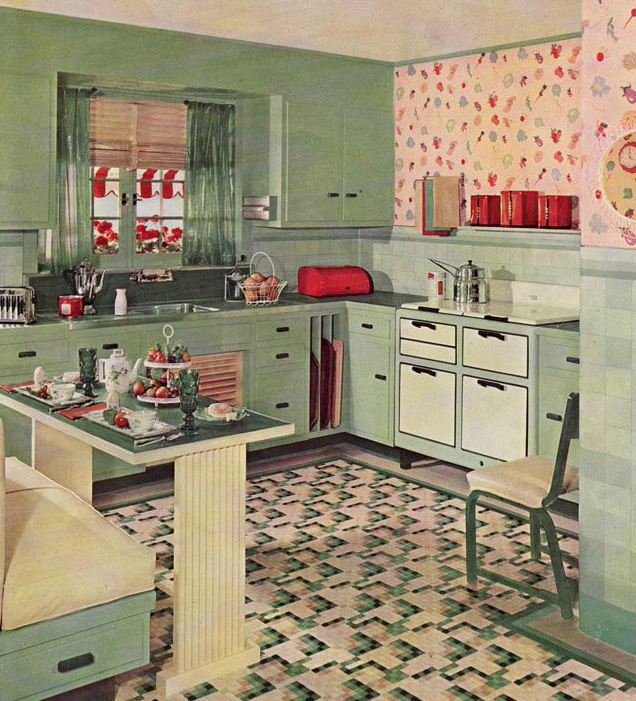
They were designed not just for personal care, but multifunctionality—as seen in the 1937 kitchen with a sink to wash the dog. Sanitation became more of a focus, leading to the use of easily washable surfaces and built-in cabinetry. For example, the 1936 yellow Armstrong kitchen with geraniums not only provided a cheerful space to prepare meals but also boasted open shelving to display plants or dishes, marrying utility with decor. The push for minimalism in the 1930s not only reflected in individual design pieces but also in the broader layout of interior spaces. In understanding 1930s interior design, there’s an appreciation for the delicate balance between opulent and practical design elements.

Marilyn Friedman Recasts Interior Design in the 1930s — SURFACE - Surface Magazine

Marilyn Friedman Recasts Interior Design in the 1930s — SURFACE.

Posted: Fri, 20 Apr 2018 07:00:00 GMT [source]

Get Inspired By The Latest Trends In Modern Interior Design

Others who created Streamline Moderne furniture included Viennese designer Paul Frankl and industrial designer Norman Bel Geddes. After the First World War, an artistic movement began to take shape in Europe that sought to express ideas of modernity and progress. In France, this movement was known as Moderne, while in the United Kingdom, it was known as Modernistic. Among the artistic movements that significantly influenced interior decoration in the late 1920s and during the 1930s were Art Deco, Expressionism, Industrial Design, and Residential Design. Despite the financial downturn, the 1930s saw a continued fascination with modernism.

A Response to Economic Times: Simplicity and Ingenuity

Formal living rooms often featured a fireplace as the focal point, around which the furniture was arranged to encourage conversation. During the 1930s, you would have witnessed the profound effect of the Great Depression, stemming from the catastrophic Stock Market Crash of 1929. This economic downturn reshaped many aspects of daily life, including the domain of housing design and architecture. There’s a wealth of potential in these pre-war homes, from their generous proportions to their built-to-last quality – more than three million UK homes were built during this decade. The streamlined, geometric tile accents add an undeniable Deco touch without going overboard. To better understand Art Deco—and get a few design ideas—consider both historic examples and modern interpretations designed by Lagrange and Moon.

True Colors for an Interior Designer’s 1930s House

1930s interior design

By incorporating elements of 1930s design into your space, you can create a nostalgic escape that transports you to a bygone era. Because the 1930s and 1940s were known for freely integrating old and new pieces, don’t be afraid to adopt this same approach for your own vintage kitchen design project. For example, modern kitchens might include a wine cooler while still incorporating retro elements, like an enameled two-door refrigerator and a vintage color scheme.

The idea of prefabricated housing — factory-made mass-produced parts shipped like self-contained Erector Sets to a construction site — was not a new idea in the 1940s or 1950s. In fact, many cast-iron buildings were produced this way in the late 1800s and shipped all over the world. Later, in the mid-twentieth century, factory-built mobile homes gave rise to entire communities of steel housing.

Jewel tones like emerald, gold, and sapphire are seen in this sitting area designed by Jessica Lagrange Interiors. Context aside, Kristie is a firm believer in following one’s gut reaction to a specific color. “The day before we moved in, we stayed up all night replacing the kitchen floor,” recalls Kristie, who couldn’t wait to cover over its 1980s beige vinyl.

These Vintage Photos Show the Elegant House Interiors of the 1930s

The Bauhaus philosophy was all about “form follows function” with design elements focused on utility rather than decoration, fostering a sense of simplicity and order in interior spaces. The 1930s was a transformative decade for interior design, marked significantly by the Great Depression. These years fostered an environment of creativity and innovation as people sought comfort and beauty in their homes amidst economic challenges.

It’s also worth considering the installation of double-glazed windows if they haven’t already been fitted. Your 1930s home may charm you with its history, but it’s essential to check the insulation. Back in the day, insulation standards were not as stringent as they are now, which can mean your house might be letting out a lot more heat than necessary. When considering a 1930s house, you’ll want to assess how it measures up in terms of energy efficiency and whether it can support today’s technology and amenities. You would typically see a more segmented layout, with clear distinctions between rooms.

Characterized by geometric shapes, bold colors, and lavish materials, Art Deco design exuded a sense of wealth and sophistication that reflected the optimism and prosperity of the time. One of the key characteristics of 1930s interior design is the use of bold geometric shapes and patterns. Think Art Deco-inspired motifs, such as chevron, sunbursts, and zigzags, that add a touch of drama and sophistication to any space.

That same year, Herman Miller shows its first modern furniture, designed by Gilbert Rohde, at the Century of Progress world’s fair in Chicago. In 1935, the ocean liner Normandie, its interior designed by Jean Dunand and Emile-Jacques Ruhlmann, among others, takes it maiden voyage. The following year, an architecture firm called Skidmore, Owings & Merrill hangs out a shingle. Dorothy Draper redefined interior decoration with her bold and colorful aesthetics. Her approach was an antithesis to minimalism; she believed in using bright, contrasting colors and large prints that breathed life into a space. You might recognize her style from the famous Greenbrier Resort in West Virginia, where her use of striking patterns and vibrant hues caught everyone’s attention.

The image above is from the 1929 silent film “Our Modern Maidens” directed by Jack Conway. It included a sweeping staircase, a fireplace with straight lines, and a gold and black doorway. From the glitz and gold hues of 1920s art deco to the pink porcelain of 1980s bathrooms, interior design has run the gamut from bold to modest and back again over the last century.

Your home’s exterior would likely include a patio or terrace, furnished with wrought iron or wooden furniture, providing a comfortable setting for tea parties or leisure reading. Enameled metal tables and chairs were not only trendy but also easy to clean—a major plus for any busy household. 1937 – Nelson and Mary Rockefeller move into their New York apartment, designed by Jean-Michel Frank.

To take the idea to the next level, don’t hesitate to light the room up a bit with bright colors. Flaunting one's wealth, whether in one's clothes or the interior design of one's home, was frowned upon, keeping the minimalist aesthetic alive. Others opted for secondhand furniture versus purchasing new items to refresh their living spaces. Introduced at the 1925 Exposition Internationale des Arts Décoratifs et Industriels Modernes in Paris, designers expressed art deco through luxurious upholstery and heavily ornamented decor. Bold patterns and stylized interpretations of natural wonders like sun rays and geometric ones like chevrons abound in everything from wood inlays to chandeliers and doors. Over the years, interior home designs have reflected personal styles and events of each era.

True, you might want to consult with a professional, but if you take the little-by-little approach, you should be able to pull it off. Painting the kitchen green, putting a retro couch in the living room, or adding luxurious touches to the bedroom will be enough to make your guests say, “Wow! It has a dining area and a lounge area on the left and right sides of the custom-made vase that sits in the middle. The soft pink on the walls, white ceiling, and green furniture are an Art Deco fan’s dream come true.

1930s Interior Design: Embracing Vintage Charm and Elegance

1930s interior design

Generally, Art Nouveau was much more organic, often making use of more fluid, curved lines. Art Nouveau, though seen in architecture, is most prevalent in the decorative arts. It originated in the 1880s and often featured forms and motifs inspired by vines, flower stems, or other natural elements.

Defining elements and characteristics of Art Deco interior design

The couches were always monochrome, and there were never any designs or patterns like flowers or vines. The design style was always bold and blocky, with edges similar to vehicles of the time. Famed French designer Emile-Jacques Ruhlmann is world-renowned for popularizing this technique.

Guide to Mid-Century Homes, 1930 to 1965

But the Lustron Corporation in Columbus, Ohio put a modern spin on the idea of prefab metal homes, and orders for these affordable houses poured in. In this image, a woman bakes in her kitchen circa 1975 with its cabinets in harvest gold, one of the signature design colors of the decade. Design’s influence from each time period can be seen in art, film, and architecture, and everyday lifestyle choices. The 1930s or 1940s kitchen wouldn’t be complete without their iconic enameled appliances. Often seen in white, enameled appliances in the 1930s and 1940s were also found in bright colors such as red, blue, and green.

#12 Sealex Veltone linoleum living room, 1931

Art Deco furniture was very rectilinear, meaning it emphasized geometric and vertical lines. Designs often included repeating patterns of shapes like zigzags, sunbursts, and chevrons. Sometimes it echoed Egyptian influence in very stylized versions of lotus flowers and scarab beetles. Art Deco and Streamline Moderne were the two most popular furniture styles in the 1930s. Art Deco, which first appeared in France, celebrated the modern world through architecture, art, and even home furnishings.

They also reflect the Industrial Age, when objects could be mass-produced and manufactured using cost-saving processes. For example, many pieces of furniture were decorated through the use of thin veneers, which are layers of exotic hardwoods. The surface might be a beautiful mahogany or stunning tiger maple, but the wood underneath was of lesser quality, which meant the piece cost less than one made completely of expensive hardwood. Science and technology in the 1930s and discoveries related to ideas like aerodynamics also impacted furniture design. The Roaring Twenties had ended, and the Great Depression was making life challenging for many people. But advances in industries, technology, and mass production also meant household goods were available at a lower cost to more and more people.

If you’re lucky, your home might retain the ornate ceiling details, which were a hallmark of this era—think plasterwork and ceiling roses. If you look around, your home might also include elements such as a garage or pergola, and a garden that provides privacy and space, a valuable asset of many 1930s properties as noted by Finnterior Designer. Speaking of that flow-enabling green, years into the renovation the couple dug into a living room wall and found traces of an almost identical green under layers of paint going back to 1940. Some reluctant home buyers cave at the sight of nodding hydrangeas and a crooked stone path, others under the heady influence of a gleaming six-burner range. Picture an armoire that once stood in an uncle’s gift shop, spiffed up to serve as a closet for the master bedroom.

1930s interior design

Their work influenced the domestic interiors of the time and continues to influence contemporary design trends. To bring the timeless elegance of Art Deco into your own home, consider incorporating key elements of the style into your decor. Start by choosing a color palette of black, white, gold, and silver to create a sophisticated and glamorous backdrop for your space. Look for furniture pieces with sleek lines, curved shapes, and luxurious materials to add a touch of Art Deco elegance to your interior. While some may argue the era of Art Deco interior design is over, it’s undeniable that its spirit lives on. “When we’re talking about Art Deco, generally we’re thinking of the style and aesthetic most popular during the 1920s and ’30s,” says Jennifer Durand, design director at Jessica Lagrange Interiors.

: Midcentury Modern

This Del Ray Rowhouse's Design Takes Cues from its 1930s Roots - Northern Virginia Magazine

This Del Ray Rowhouse's Design Takes Cues from its 1930s Roots.

Posted: Tue, 20 Feb 2024 08:00:00 GMT [source]

The classic, stylish appeal of a Tiffany lamp could be seen in many homes, alongside newer, more streamlined floor and table lamps. You’ll find that textiles in the 1930s often featured geometric patterns or botanical prints, contributing an air of sophistication to any room. Your choice of rugs could vary from the opulent Art Deco styles to simpler, more neutral colors that complement the Streamline Moderne influence of the era. These floor coverings were not just functional; they were key in setting the tone for the room’s decor. In the 1930s, interior design was shaped by powerful design styles and movements that brought sophistication, symmetry, and a fusion of art and technology to the forefront of home decor. All models freely adapted ideas from Frank Lloyd Wright's Usonian vision — natural lighting, open and expandable floor plans, and the merging of exterior and interior spaces.

It stood as a counterpoint to the sleek minimalism of Modernism, appealing to those who sought comfort in tradition amidst the uncertainties of the time. Conversely, the Colonial Revival movement drew inspiration from the past, reviving elements of early American design. But it could be replaced with a table made of glass or steel with strong lines to replicate Streamline Moderne vibes. Books might not be the most popular medium for recording information today, but they sure do look beautiful on a shelf. As for the leather couch, it’s a fine example of premium-quality craftsmanship, which is an integral part of Art Deco. The cabinets/drawers on both sides of the couch, gramophone, and vintage voice recorder make the room feel even more 1930s.

1930s interior design

These spaces often featured rich wood finishes and a statement dining table as the centerpiece. Art Deco emerged as a luxurious and optimistic style that became symbolic of the era. Your home might feature geometric patterns, bold curves, and the iconic stepped or ziggurat outlines that conveyed elegance and progressivism. Before diving into the specifics, you should understand that the 1930s were an era of stark contrasts in home decor, influenced heavily by economic and cultural shifts.

The use of glass was both functional for letting in light and thoughtful from an aesthetic angle, providing a distinctive look that meshed well with the other exterior features. Georgian homes are recognizable by their symmetrical layout and classic proportions. Often made of brick, these houses featured paneled doors centered at the front façade, flanked by multi-paned windows that exuded elegance from an earlier era. The Depression caused widespread hardship, drastically influencing the choices in building homes.

The 1930s saw a rich color palette that ranged from deep greens and blues to softer creams and pastels. Your walls might have boasted the glossy finish of carrara structural glass or the warmth of mahogany wood panels, both popular materials of the time. When stepping into the realm of 1930s interior design, you’re embracing a period marked by a unique blend of sophistication and modernity. Your choices in color and material palettes, along with furniture and accessory selections, are central to capturing the essence of this era. As you delve into the hallmarks of 1930s interior design, you’ll notice how designers of that era laid the groundwork for the modern concepts of living spaces we’re familiar with today.

Sure, you can always repaint, but generally you want something that will work for them as they grow—and won’t set your teeth on edge in the meantime. Just last year, with two growing daughters, the couple demolished two walls upstairs that didn’t appear to be original, turning a bedroom into a common area between the girls’ rooms. After years of scratching their heads over the upstairs bath—a dysfunctional space crammed under the eaves—they rebuilt it from scratch. Subway tile gives the new bath period appeal, while emerald-green walls and black trim give it a contemporary edge. Selecting the right combination of colors and patterns could transport you to an era where style was both an escape and a reflection of the world’s progressing modernity.

Art Deco started in France around 1925 and celebrated the modern world through furniture, art, and architecture. Designers also used bold contrasting colors like gold, black, and silver and incorporated modern materials like glass, chrome, and Bakelite, a type of plastic. Designers like Frenchman Emile-Jacques Ruhlmann created spectacular examples of Art Deco furniture with sleek surfaces and curving lines.

Still, they mostly use bright colors that look fresh, exciting, and even a bit childish. So, don’t be surprised when you see blue, pink, yellow, or orange walls coexisting with antique armchairs, concrete walls and floors, and wooden furniture or stainless-steel appliances. "Fixer Upper" hosts Chip and Joanna Gaines helped popularize modern farmhouse features like shiplap and worn wood furniture, while maximalists enjoyed layering different styles and objects. Whether one wanted a boho- or industrial loft-style look, there was no shortage of options. Sponge-painted and decal-covered walls, floral and gingham decor, shabby chic interiors filled with frilly fabrics and worn pieces—anything went during the era.

These Hair Dryers and Stylers Work Like Beyoncé's Dyson, Shoppers Say

This is a particularly good hair dryer for those who want something that doesn't sound like a jet engine taking off in your bathroom. ...